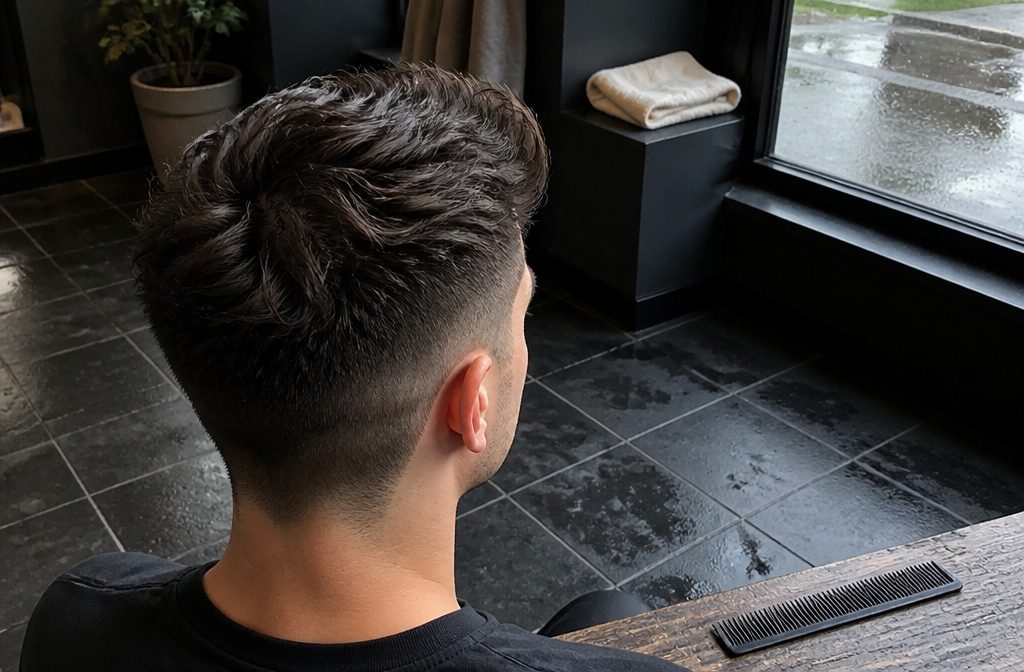
A textured quiff is a short-sided cut with 3–4 inches left at the front, lifted up and back and styled matte with your fingers instead of combed smooth.
Upkeep is higher with a skin fade, which needs a barber visit every 1–2 weeks, while a scissor taper stretches to 4–6. Pick the sides based on your calendar.
Classic Modern Quiff
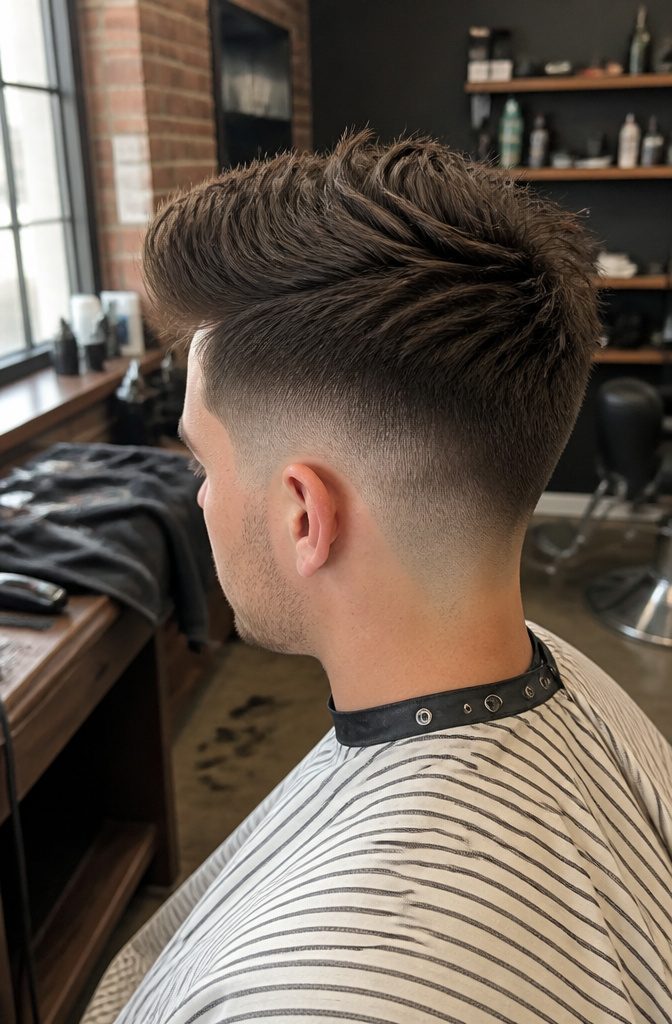
This is the version I’d point a first-timer toward. Roughly 3 inches on top with a #1 blending to a #3 on the sides gives enough length to lift at the front without turning the cut into a project.
Ask for 3–4 inches at the front, shorter toward the crown, with a short taper or low fade.
Styling is simple: blow-dry the front upward and back, then work in matte clay for a piecey finish.
The result is less rigid than a traditional 1950s quiff, which leans on pomade for a smooth, clean look. Matte product keeps this one rougher and more current, and it works at the office or on a weekend.
Messy Tousled Quiff
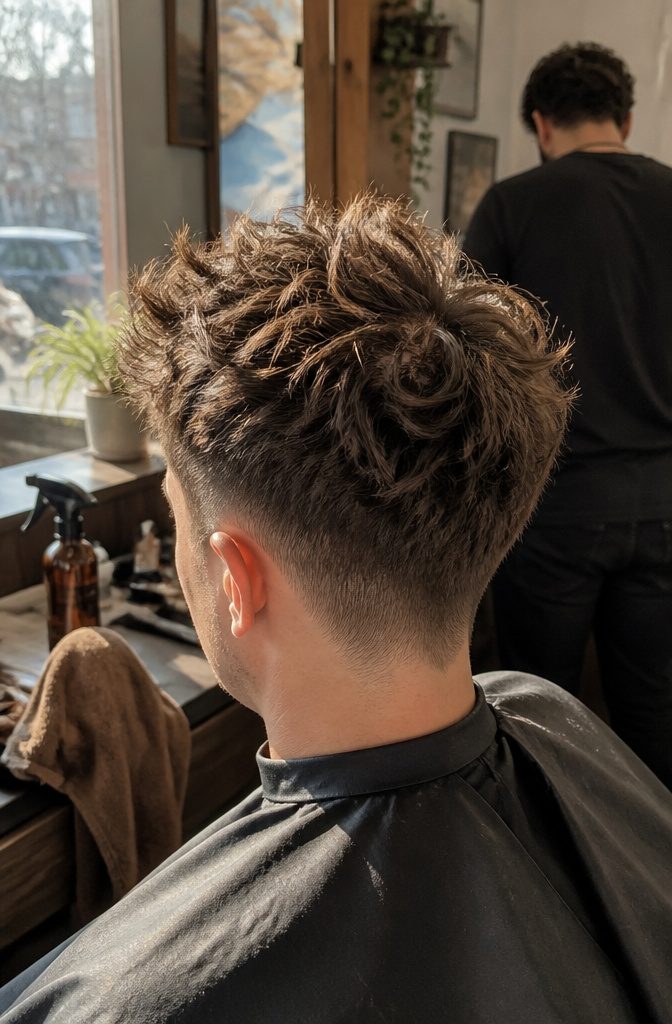
Choppier layers are what make this quiff look undone, and they work best on thick hair that needs weight taken out. Mist sea salt spray into towel-dried hair first, then add matte paste or texture powder for grip.
Use your fingertips instead of a brush or comb: lift the front, then pinch and twist the ends so the strands break into separate pieces.
A comb lines everything up in one direction and gives you the neat, classic shape, which is the opposite of this look.
Go light on product, because excess weight flattens the texture you just built. On a short top with a low fade, the whole routine takes two minutes, which makes it my pick for busy mornings.
Short Quiff at 1.5–2 Inches
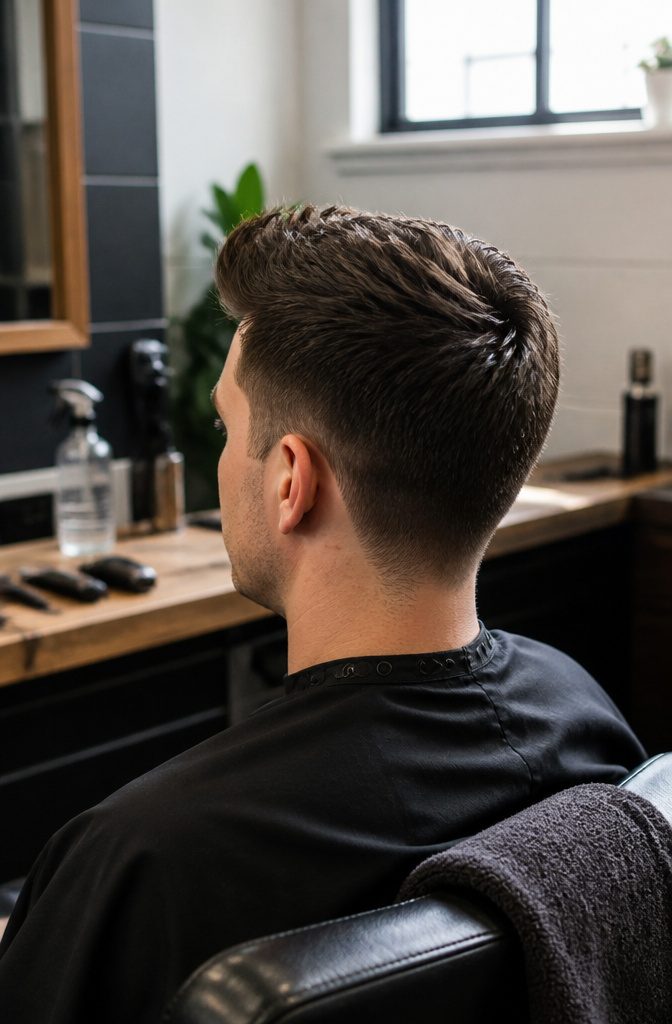
A compact top styles in under a minute, so it suits anyone who is always rushing out the door and wants a neat cut with a noticeable lift at the front.
At 1.5–2 inches, there is just enough length to spike or push up the front.
Some cuts run 2–3 inches instead. That extra inch gives the front more to work with, while the shorter end stays tidier, so pick based on how much lift you want.
Ask for a short, textured top with enough length at the front to hold the quiff shape. A pea-sized amount of styling cream is plenty, since too much product weighs a short top down.
Medium Quiff at 2.5–4 Inches
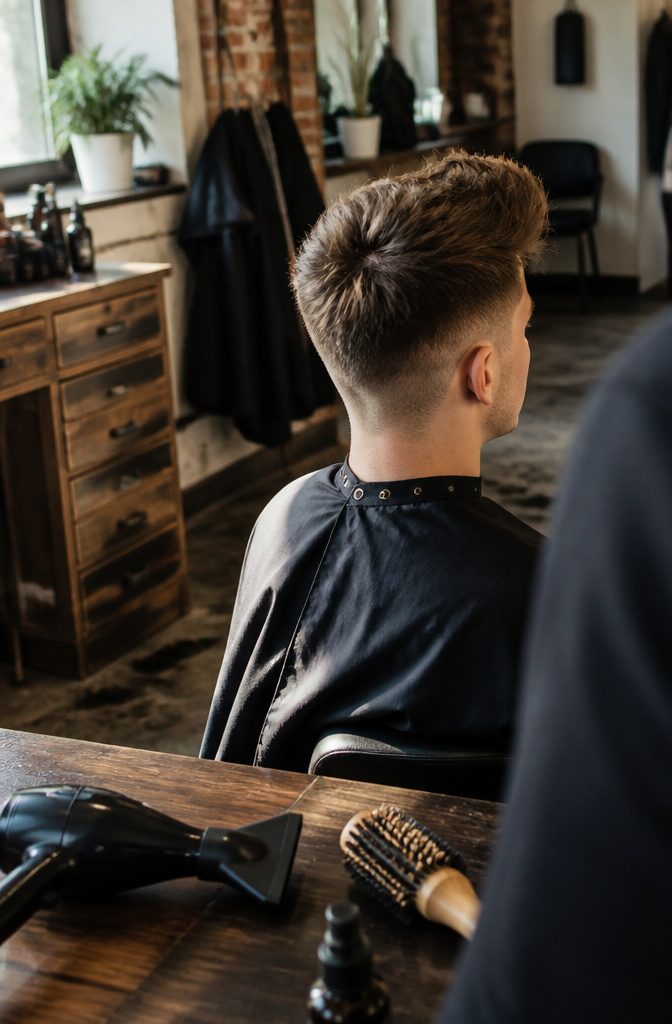
A medium quiff runs 2.5–4 inches on top, and I’d ask for 3 at the front if volume is the goal, because hair needs that length to build real height.
Have the barber cut it shorter toward the crown with heavy texturing, and keep the sides to a short taper or low fade, #1 blending to #3.
The extra length gives you a smooth sweep, a textured finish or a fuller shape, and you can switch between slick and messy in minutes. It also handles wind and humidity better than a longer cut.
The cost is time: expect to use a blow-dryer most mornings, drying upward, to hold the lift through the day. A light pre-styling spray adds volume without weighing it down.
Long Quiff at 4–5+ Inches
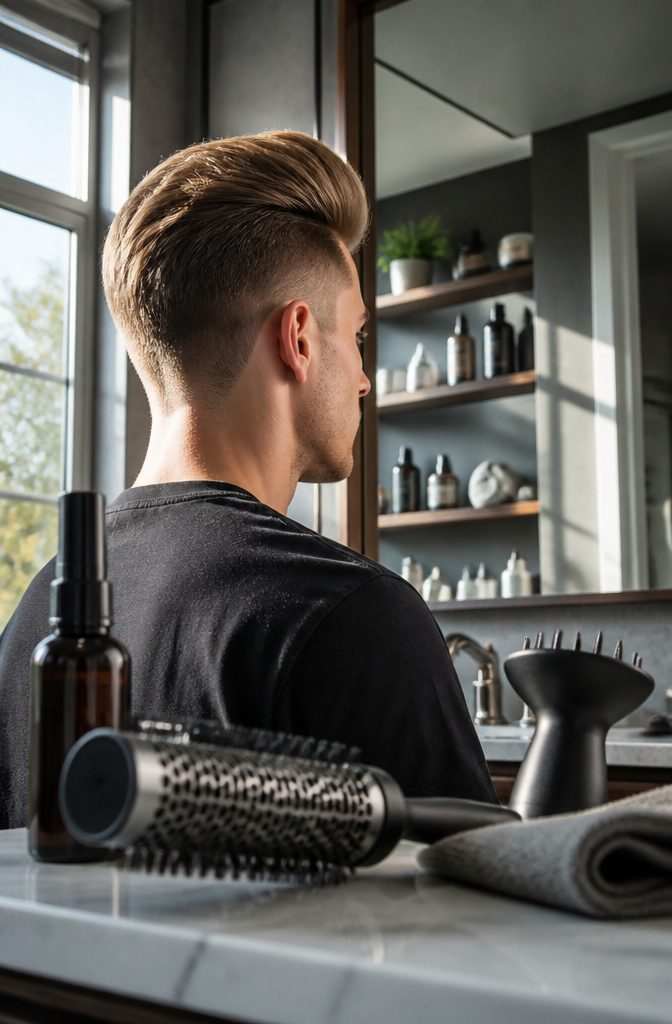
A long quiff runs 4–5+ inches on top, and it only holds that height with a strong-hold product and a blow dryer. Skip either and the front slumps by midday.
Weight is what collapses it. A heavy pomade drags the top down, so I’d build the lift with volumizing mousse at the roots and lock it with hairspray.
Apply heat protectant before drying, since long hair takes more heat and more time. Then round-brush the front up and back as it dries.
This cut wants denser hair to stand firm.
On busy days, dry shampoo or texturizing powder adds grip and stretches the style. Tell your barber to leave at least 4 inches on top.
Low-Fade Quiff
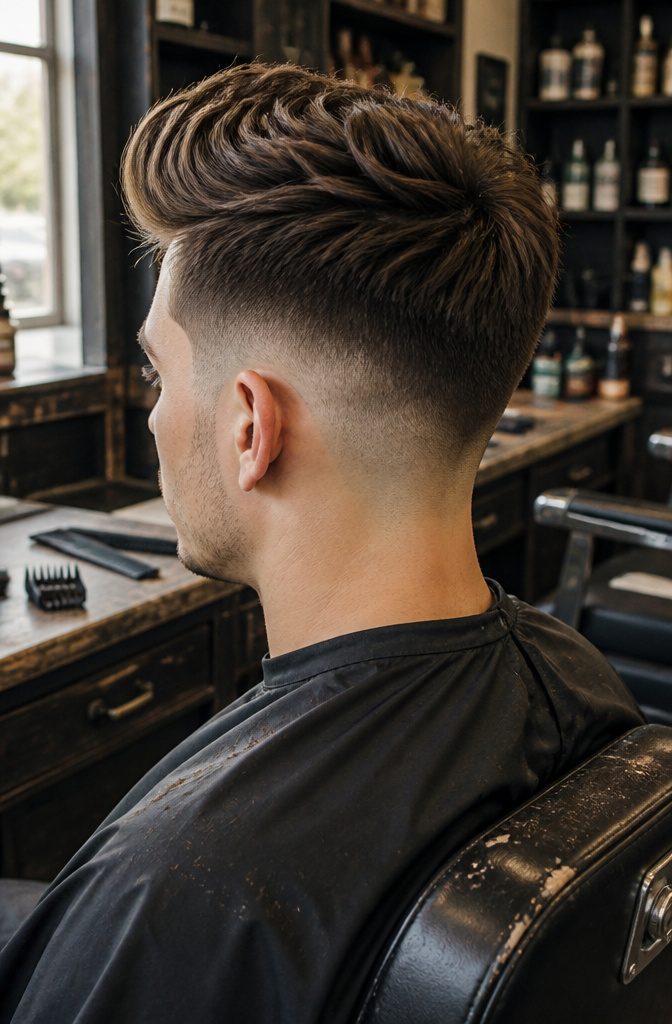
A low fade starts just above the ears, so the sides look cut rather than shaved. That makes it the safest first fade, and it’s easy to wear at the office while the top keeps its texture.
Ask for the height by name: low.
The guard at the bottom is usually a #0, #0.5, #1 or #2, and a #1 blending up to a #3 is a common map to hand your barber. If you’re nervous, start at #2.
Book a trim every 3–4 weeks to keep the blend crisp. Stretching to 5 is the limit before it reads as grown out.
Mid-Fade Quiff
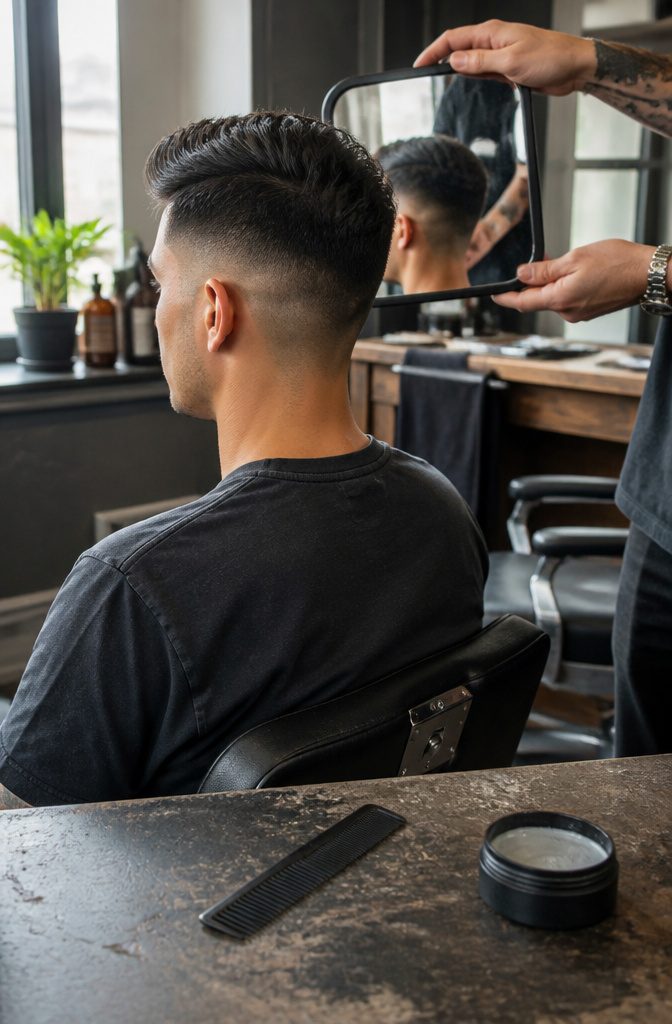
Start the fade around temple height and you get more contrast than a low fade gives, without the boldness of a high one.
It’s the middle ground between safe and statement, and a lot of guys ask for it after seeing Mason Mount.
I’d pick it over a low fade when the top is short, since the fade keeps the outline sharp without any extra length up top. Ask for short layers on top and a fade that begins at the temple.
It works for fine to medium hair, and the structure on the sides keeps thick or coarse hair manageable. Matte clay keeps the finish natural.
High and Skin Fade Quiff
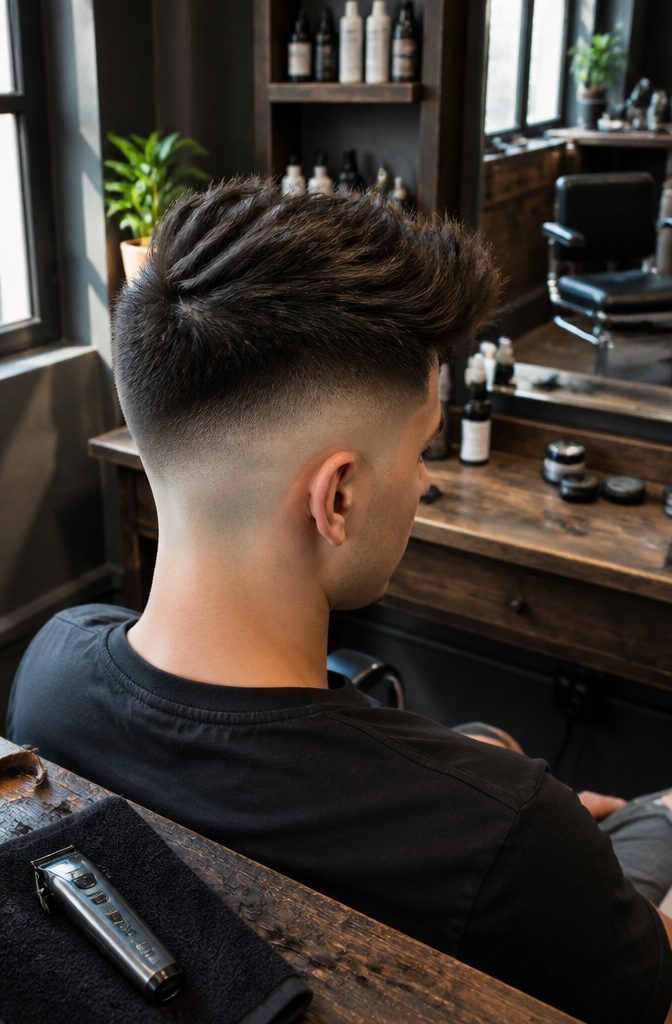
A high fade starts near the top corner of the head, so the sides go close to bare and the contrast with the longer top is as bold as a quiff gets.
Round faces are the pairing to try: the shaved sides visually slim the face, and I’d pick this over a lower fade for that shape.
Ask for a high fade, keep the top slightly longer, and have the barber taper aggressively behind the ear to sharpen the bone structure.
The cost is the calendar. A skin fade needs a barber visit every 1–2 weeks to stay crisp.
Stretch to 3–4 weeks and the edge softens. If that schedule isn’t realistic, I’d skip the skin finish.
Tapered Quiff Without a Fade
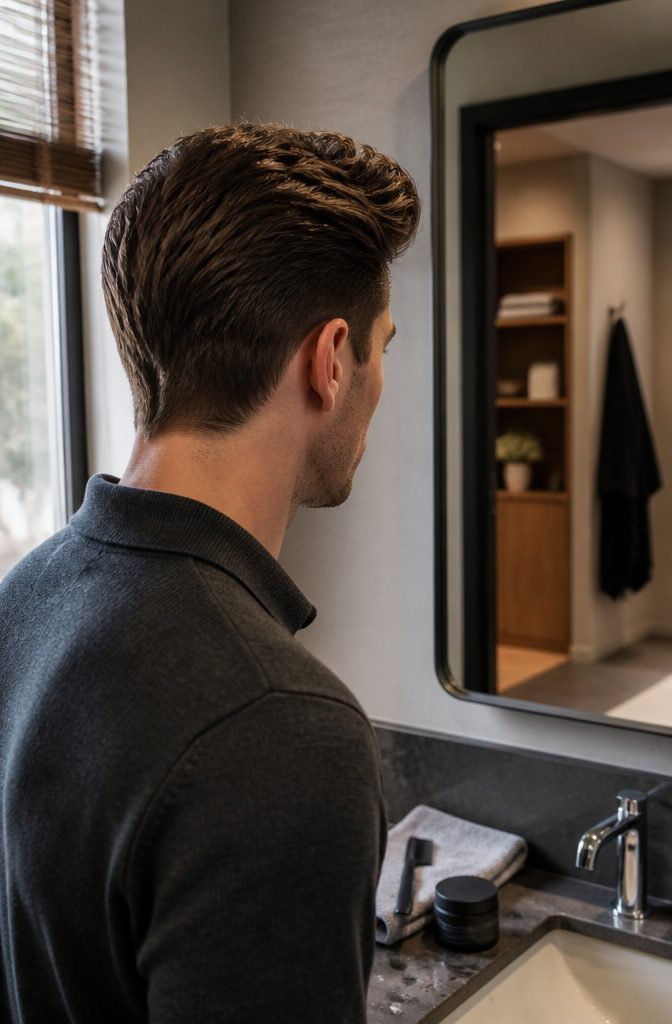
A tapered quiff keeps the sides soft: the hair graduates naturally at the sideburns and neckline, with no skin showing.
Ask for a scissor taper instead of a low fade (#1 to #3), and say "3 to 4 inches at the front, shorter towards the crown, heavily textured." Without that graduation on top, the hair is too heavy to lift.
I’d pick this version for a conservative office. It grows out gracefully, and you can wait 4–6 weeks between visits, the longest interval of any side finish.
A crisp fade needs a trim every 3 to 4 weeks. You give up some contrast, so the top stands out less against the sides.
Quiff for Straight Hair
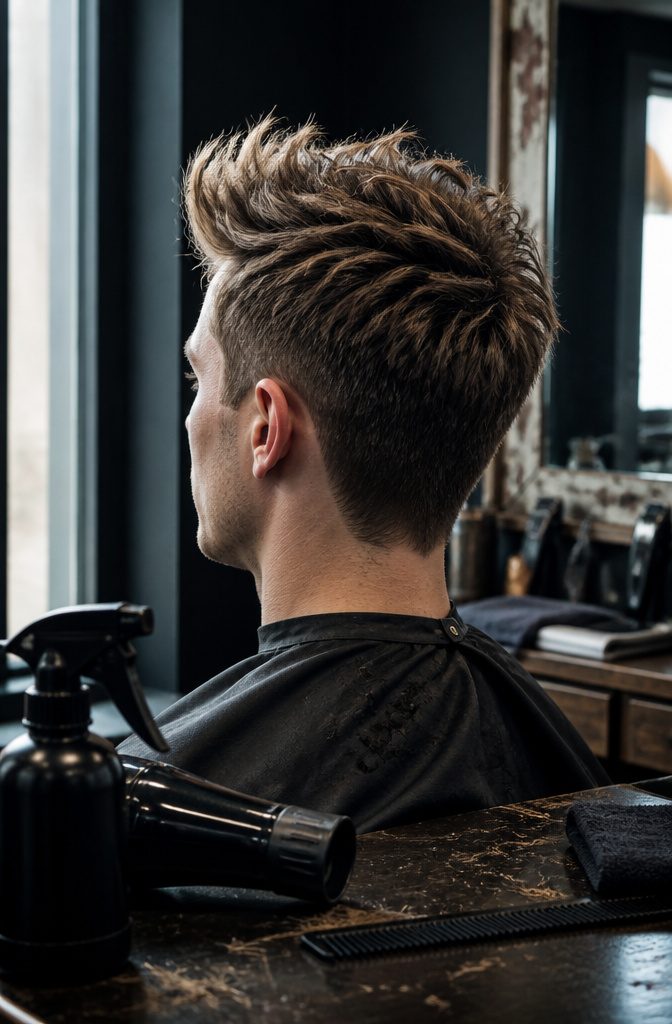
Straight hair falls flat, so this version fakes texture with point-cutting.
The barber snips into the ends on top at an angle, which leaves choppy layers that separate and move instead of lying in one smooth sheet. Ask for point-cutting on top by name.
Mist sea salt spray into damp hair before you pick up the dryer. Straight strands have little natural grip, and the salt gives them some.
The finished look is roughly 80% blow-dry and 20% product.
The dryer builds the height, and product only holds it there. I’d still call the dryer non-negotiable for a true quiff, though skipping it gives a flatter, messier version that can look good in its own right.
Wavy Quiff
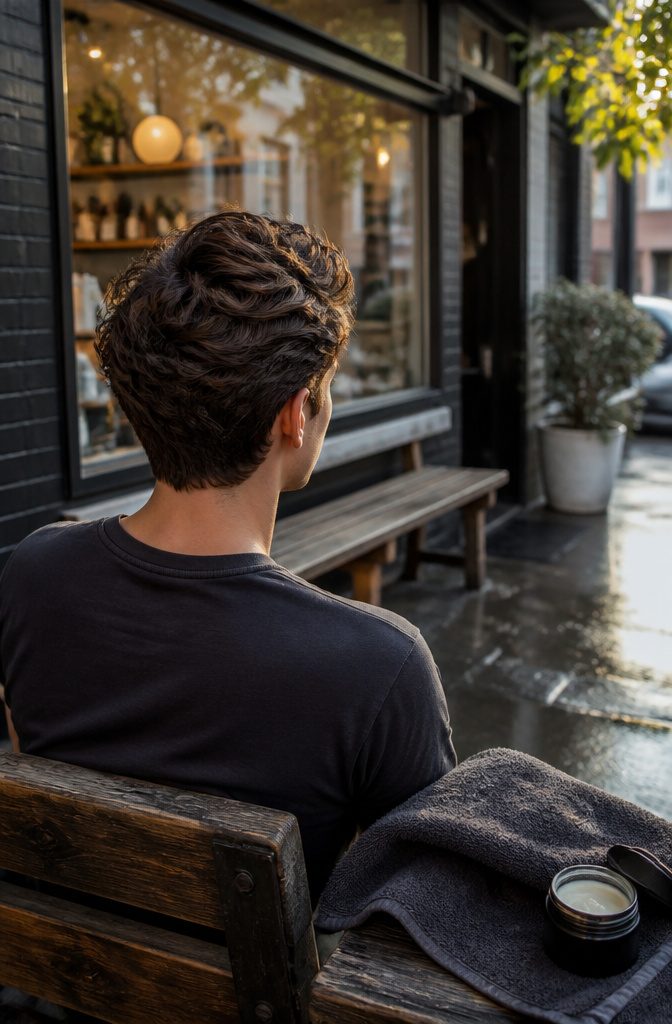
Natural waves already give a quiff its lift, so the barber’s job is to shape the top around the pattern instead of flattening it straight.
Layering around the crown removes weight and cuts frizz, which lets the waves stack up and back on their own.
At home, work a lightweight curl cream, styling lotion or leave-in through damp hair, then air-dry for a looser finish or diffuse for more body.
Guide the front up and back with your fingers rather than a brush, since brushing pulls waves out.
Heavy gels and thick pastes are the mistake here.
They weigh the waves down and flatten the lift you came for. Start with a small amount; you can add more, but you can’t easily take it out.
Curly and Coily Quiff
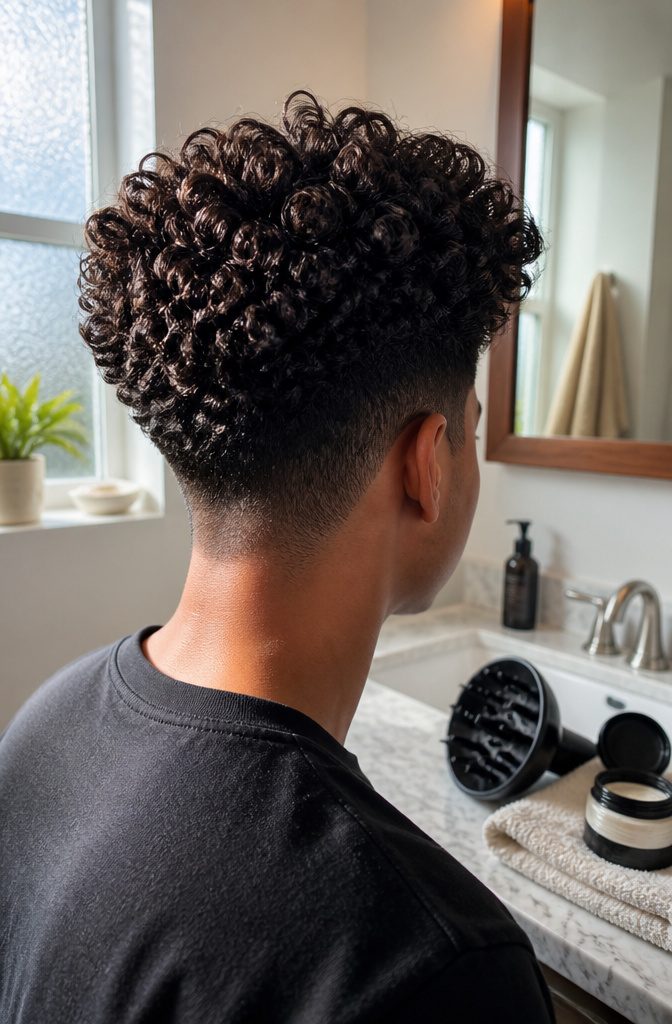
Curls bring their own volume, so the sides do the controlling. Keep them tight or tapered, because loose sides under a full top give you the "mushroom" shape.
Tell the barber to shape the top around your curl pattern, not cut it as if it were straight hair, and leave the length up there so the curls can lift.
At home, skip the brush on dry curls. A lightweight curl cream defines without stiffness.
Then air-dry or use a diffuser so the pattern stays intact instead of frizzy. On coily hair I’d skip heat entirely: twist small sections on top with a matte cream and let the texture do the work.
Thick Hair Quiff
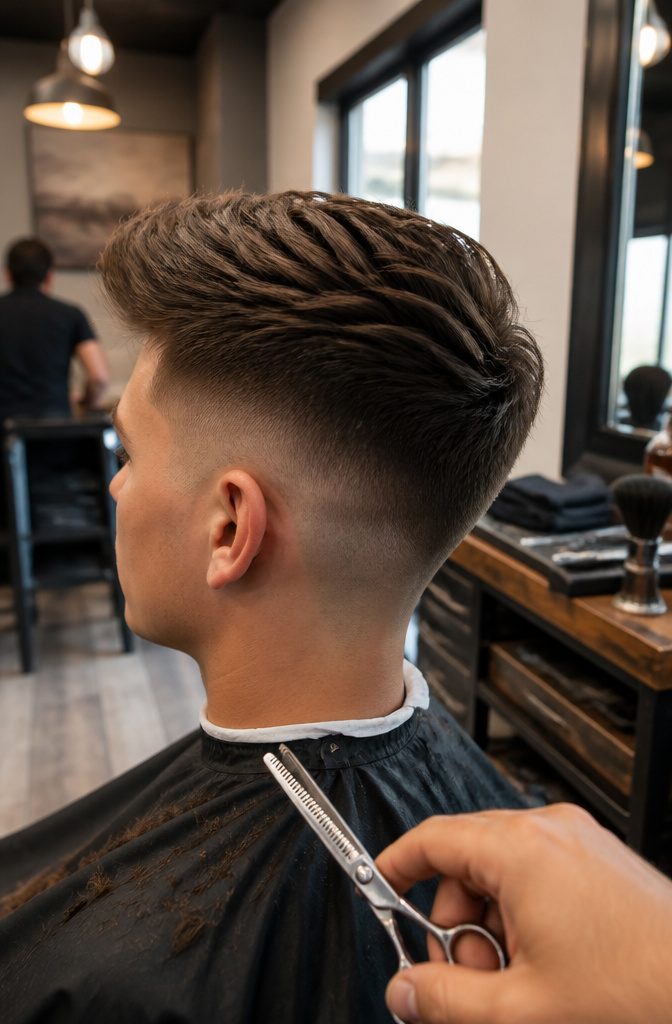
Dense hair falls under its own weight, so a thick quiff needs internal weight removed before it will stand up.
Ask for debulking: the barber uses slice cutting or thinning shears on the interior of the top, which lets the hair lift instead of sitting heavy.
Tell the barber to thin the top slightly and go easy on the front, because thinning it too aggressively leaves the quiff without body where it shows most.
A fade on the sides cuts the visual bulk and lets the fuller top stand out.
Strong-hold clay keeps dense hair upright, while a medium-hold product controls it and preserves natural body. I’d start with medium and step up only if the front sags.
Fine or Thin Hair Quiff
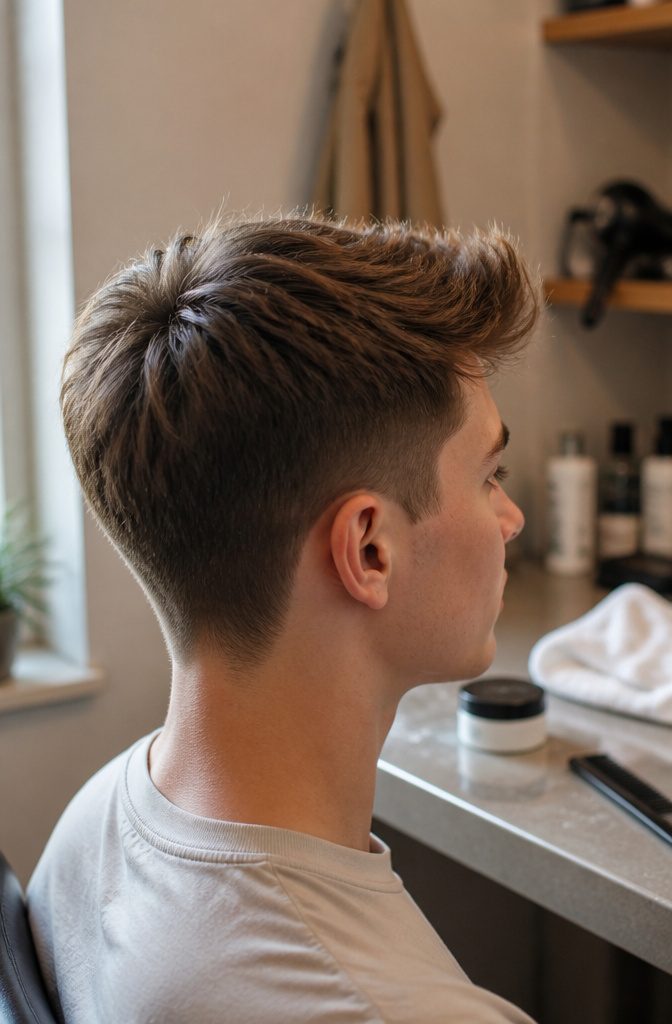
Fine hair does best with a quiff kept short: less length means less scalp showing through, and the height on top reads as density.
Ask your barber for a textured top with just enough length at the front to lift. Product decides the rest.
Lightweight texture powder or mousse is the right call, while heavy clay and anything shiny pull fine strands flat. I like a light pre-styler worked through damp hair, then a matte finisher once it’s dry.
Powder on dry hair also gives quick lift between washes without adding weight. A matte paste can work too, but how full the quiff looks still depends on your natural density, and no product fully makes up for that.
Quiff With a Beard
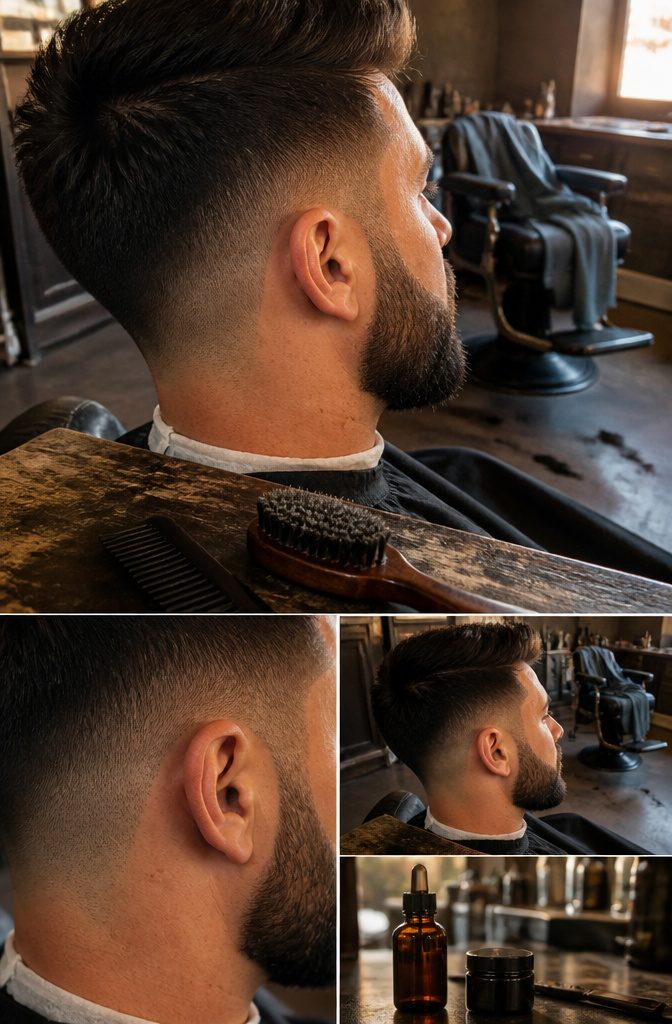
Height on top lengthens the face, and a beard gives the jaw structure that faded sides alone can’t, which is why this pairing is a strong choice for round faces.
Have the barber run the fade straight into the beard line, with the sideburn area blended so there’s no gap or hard edge.
A low or mid skin fade draws the sharpest outline between the hair on top and the beard. A tapered beard softens that handoff if you want something cleaner.
Beard length should match the sides, in my view: a short, neat beard suits a tight fade, and a fuller one looks best with a taper. Keep the edges tidy, and a little beard oil adds shine.
Undercut and Hard Part Quiff
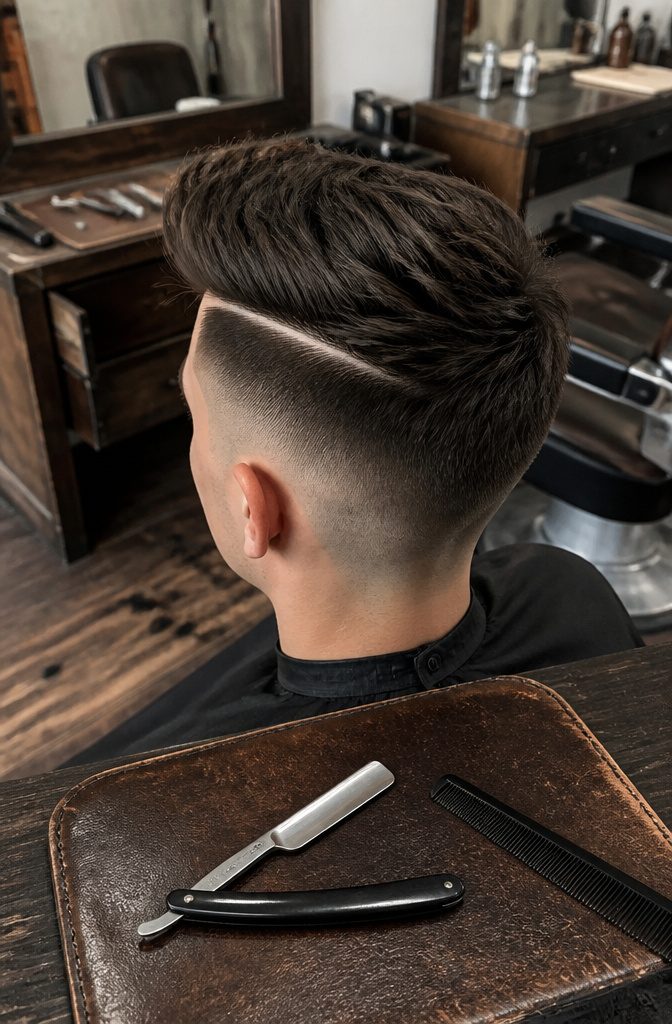
A hard part quiff drops the blend entirely: the sides are cut very short, the top stays long and swept, and nothing graduates between them.
That contrast makes the height look taller. A razored or side-swept dividing line can mark the break while the top keeps its messy volume, and a crisp line also keeps the cut looking sharp longer between visits.
I’d bring a reference photo so the line and top length match what you picture.
Upkeep is the price.
The sides grow out quickly, so book regular trims; without a fade to soften it, the gap blurs fast. Blow-dry the front up, then hold the longer top with a firm pomade or styling paste.
Spiky Forward Quiff
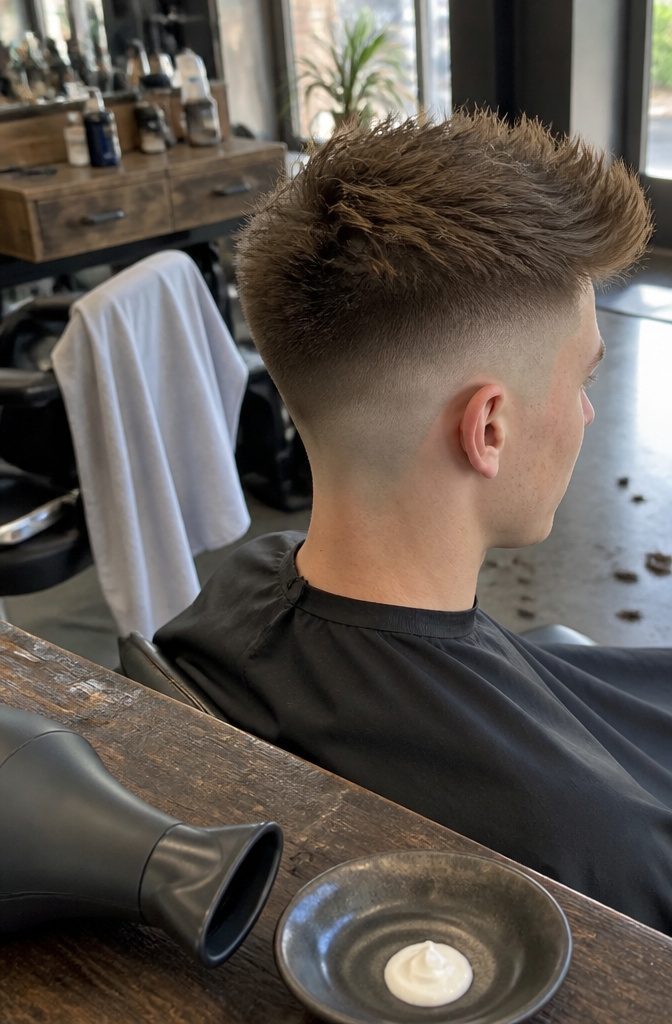
A spiky forward quiff sits between a textured crop and a traditional quiff. A crop’s fringe falls forward over the forehead, a quiff lifts the front up and back, and this cut borrows from both.
Ask for a short top with choppy layers, paired with a mid or high skin fade. The fade gives the simple top some structure, which is why the cut works on coarse or thick hair.
To style it, blow-dry quickly, then twist small sections up and forward with a dime-sized amount of matte paste or clay.
I’d pick matte over pomade here, since it cuts scalp shine and keeps the pieces looking choppy rather than slick.
Mohawk and Mullet Hybrid
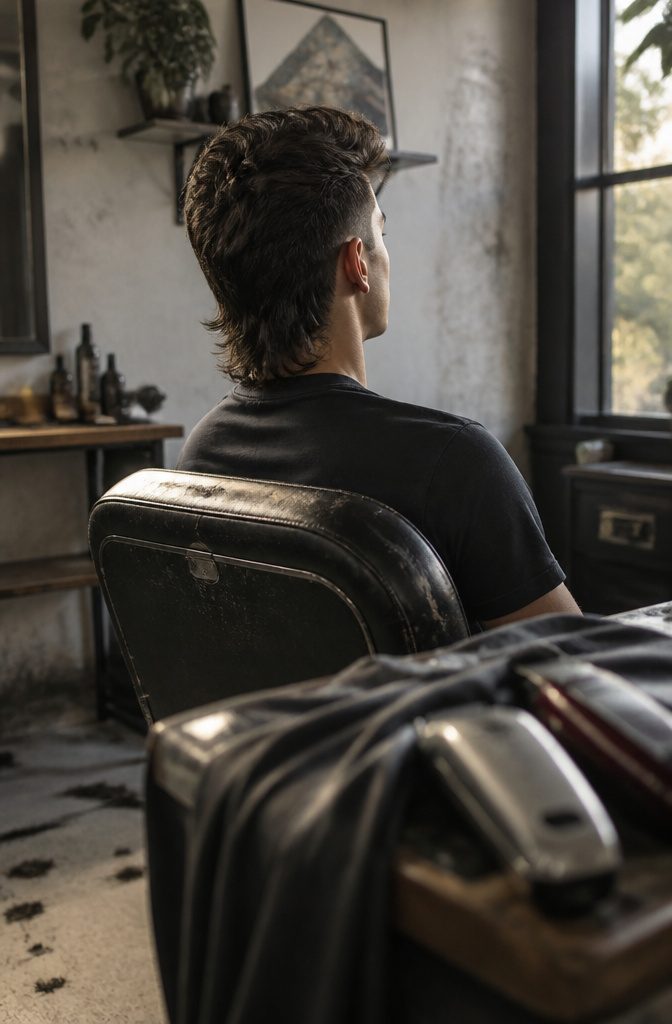
The mohawk and mullet hybrid keeps the quiff’s lifted, textured front but narrows it into a central strip, then lets the back grow longer than a standard quiff ever would.
The sides stay close, so the strip reads as a deliberate band, and the nape grows out to brush the collar.
It departs further from a standard quiff than any other shape in this guide. A classic quiff is one blended shape; this is two separate decisions, front and back.
It suits thick or wavy hair and anyone happy to be noticed.
Skip it if your workplace expects a conservative cut, and plan on the back needing more patience than the top. Bring a photo, because "mullet" alone gets very different results from different barbers.
Blonde and Salt-and-Pepper Quiff
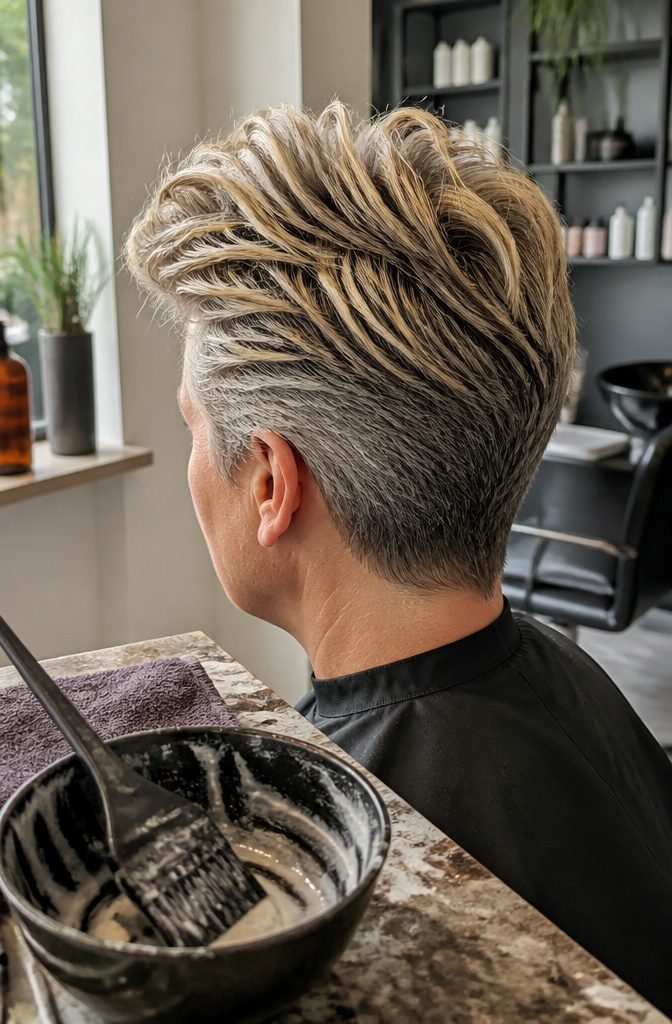
Lighter hair shows off the texture on top, so a blonde quiff looks deliberate.
Full blonde is the loudest version. Subtle highlights or just a lighter front section are easier to live with, and I’d start there if you’ve never bleached.
Bleaching changes hair condition, so talk through the process and aftercare with a qualified colorist first. At home, use purple shampoo to keep brassiness away and deep condition weekly, and go easy on heat styling.
Salt-and-pepper needs less work. Mixed grey adds visual texture on its own, so I’d keep the top slightly shorter and choose a taper over a skin fade, which looks more natural at this age.
Quiff for a Receding Hairline
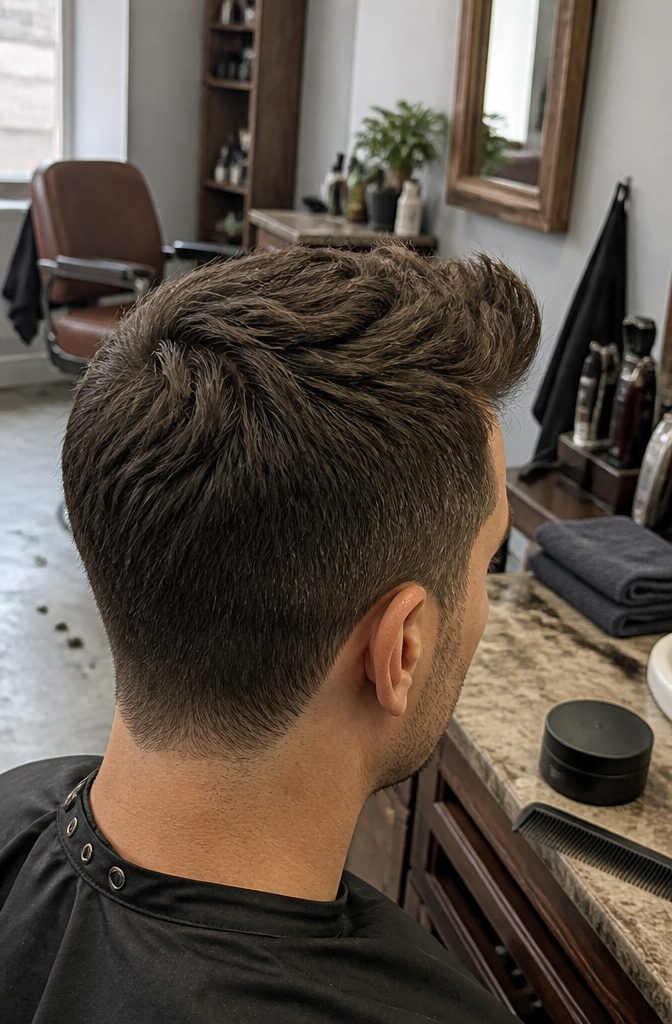
Slicking a quiff tight back exposes the recession, so I’d skip the smooth, combed-back finish.
Go messy instead. Push the hair at the corners slightly forward so it covers the temples, then lift only the center fringe.
Leave the sides alone. A matte product keeps scalp shine down, which a glossy pomade won’t.
At the chair, ask for shorter sides and back with enough length up front to brush the hair upward and slightly backward.
Name your fade or taper and your top length. Ask for a textured finish rather than a smooth one, since that is what keeps the front looking loose and full.
Teen and Mature Quiffs
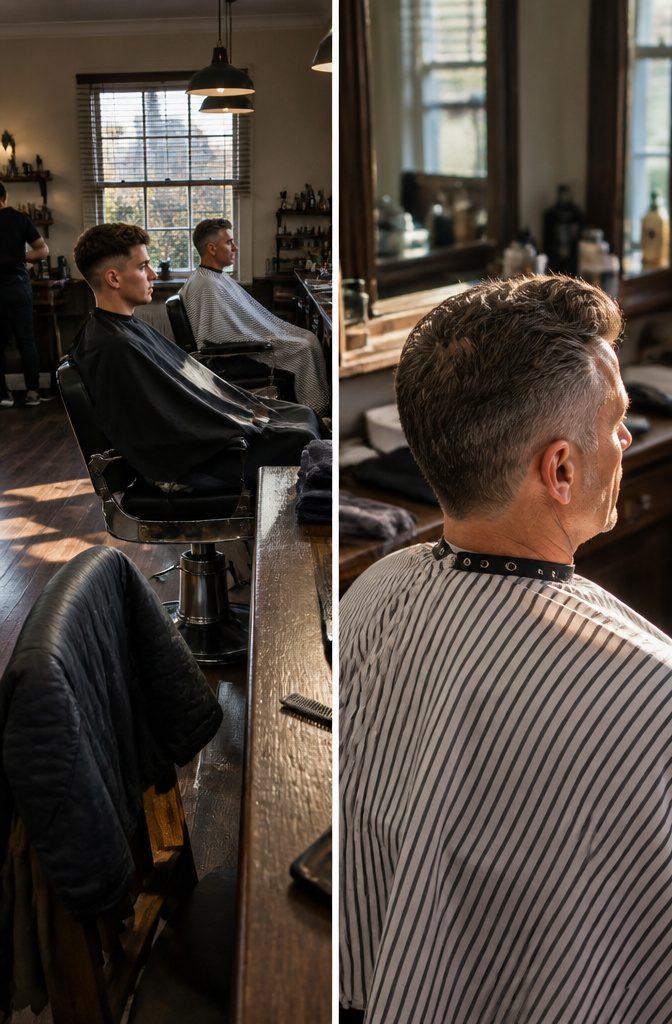
Boys and teens get the same shape with a shorter top and a lighter fade. That version is school-appropriate, and it’s easy for a parent to keep up, which is what decides whether a teen’s cut stays tidy.
For mature men, grey and natural color do much of the work, because the mixed tones add visual texture on their own.
I’d ask for a slightly shorter top and a taper rather than a skin fade, which looks more natural at this age.
Faded and tapered cuts both want a trim every three to five weeks, and a longer, softer top stays wearable a bit longer between visits. If the hair is fine, go light on product, since heavy styling can flatten it.
What Defines a Textured Quiff
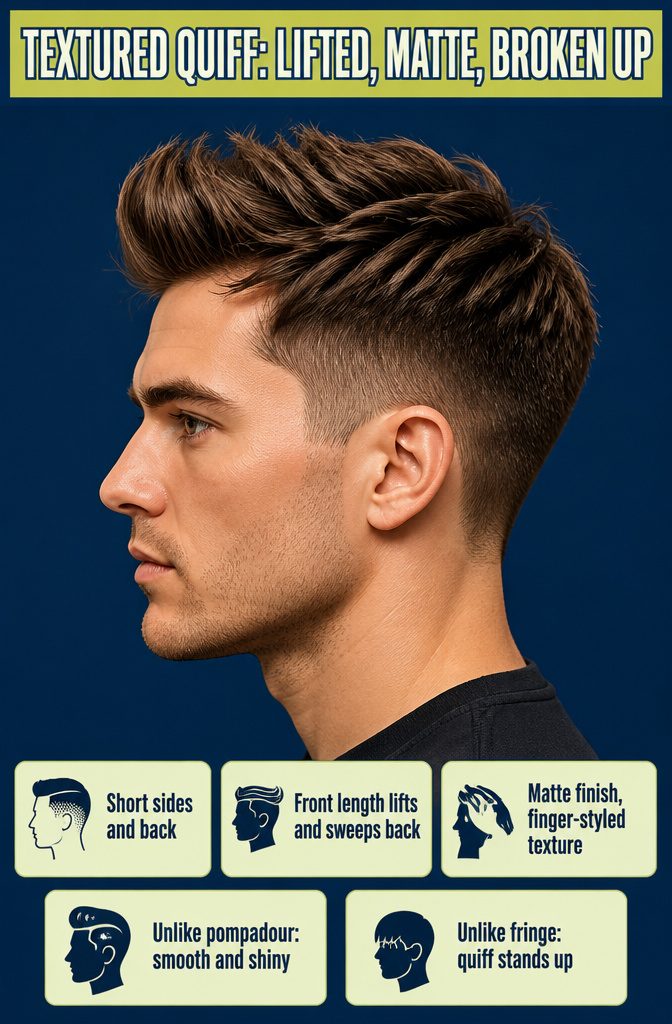
A textured quiff keeps the sides and back short and leaves length at the front, lifted up and usually swept back.
The finish is matte and broken up, styled with fingers rather than combed smooth. A pompadour is smooth, rounded and usually shiny.
A fringe falls forward over the forehead, while a quiff stands up. A textured crop points its fringe forward, so hair pushed toward the brow in your photo means a crop.
The shape comes from 1950s rock ‘n’ roll, where Elvis Presley and James Dean made it a fresh alternative to the pompadour.
David Beckham, Zayn Malik and Mason Mount wear it now. For everyday wear I’d pick the quiff; it forgives a messy morning.
What to Tell Your Barber
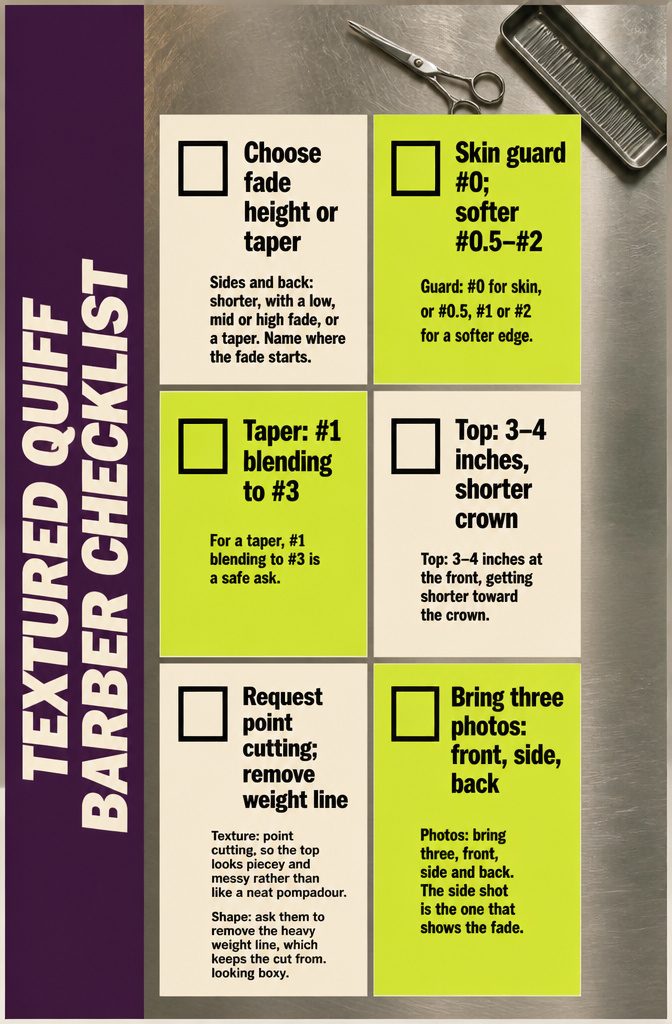
Give your barber these specifics, in this order:
- Sides and back: shorter, with a low, mid or high fade, or a taper. Name where the fade starts.
- Guard: #0 for skin, or #0.5, #1 or #2 for a softer edge. For a taper, #1 blending to #3 is a safe ask.
- Top: 3–4 inches at the front, getting shorter toward the crown.
- Texture: point cutting, so the top looks piecey and messy rather than like a neat pompadour.
- Shape: ask them to remove the heavy weight line, which keeps the cut from looking boxy.
- Photos: bring three, front, side and back. The side shot is the one that shows the fade.
Style It in 3–8 Minutes
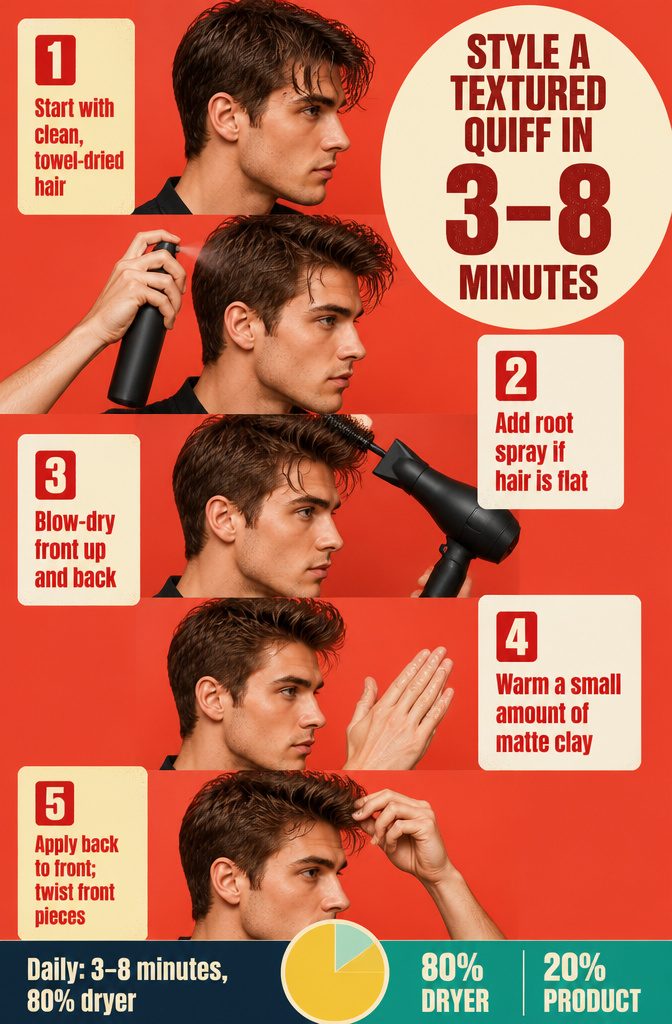
A textured quiff takes 3–8 minutes a day, and I’d spend roughly 80% of that on the blow-dryer and 20% on product.
- Start with clean, towel-dried hair that is damp, not dripping.
- Add a pre-styler if your hair is flat at the roots: a light sea-salt or volumizing spray.
- Blow-dry the front up and back, lifting with your fingers or a round brush. The By Vilain Skeleton Brush and Uppercut Quiff Roller add extra structure and volume.
- Warm a small amount of matte clay or paste between your palms until it disappears.
- Work it through from back to front, then twist a few front pieces with your fingers. Excess product weighs the top down and flattens the texture.
Matte Clay, Paste and Salt Spray
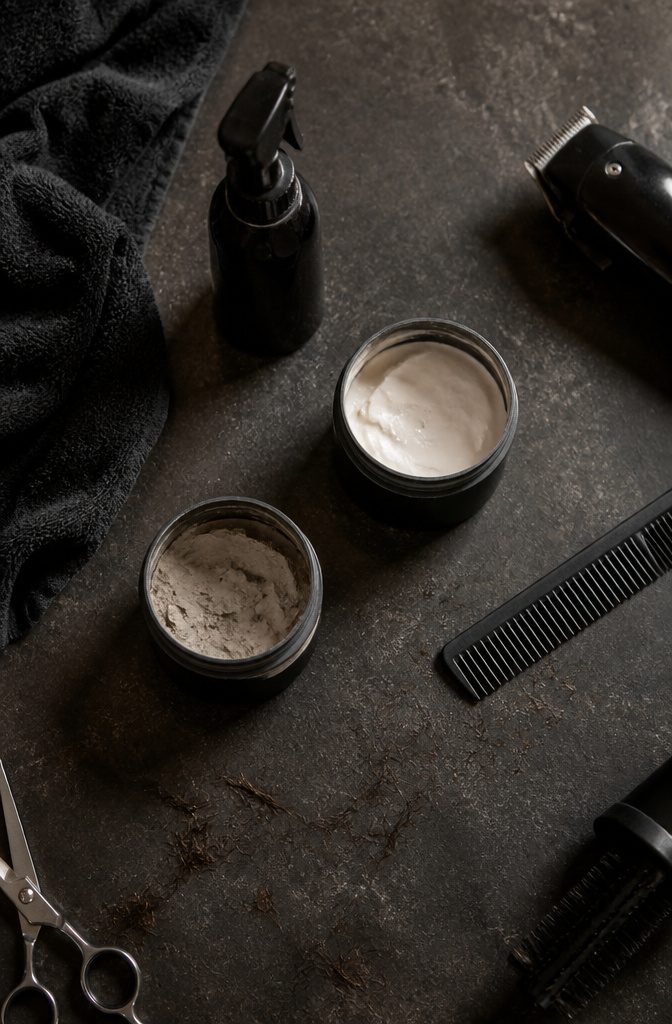
Finish decides the product, so sort by how much shine you want.
- Matte clay: the default for a natural, low-shine textured look. Matte products also give the most volume.
- Matte paste: flexible hold for everyday quiffs. Warm a small amount between your palms first.
- Texture powder: instant lift on fine hair.
- Sea salt spray: grip and beachy texture. Work it into damp hair before drying.
- Lightweight cream: low shine, and it defines waves while calming frizz.
- Pomade: smoother, shinier and more polished. I’d skip it for a tousled quiff.
Heavy clay weighs fine hair down, so reach for powder or mousse instead. Pomade pulls waves toward smooth and works against their natural shape; scrunch in cream or salt spray and let them dry.
Hair Type and Face Shape
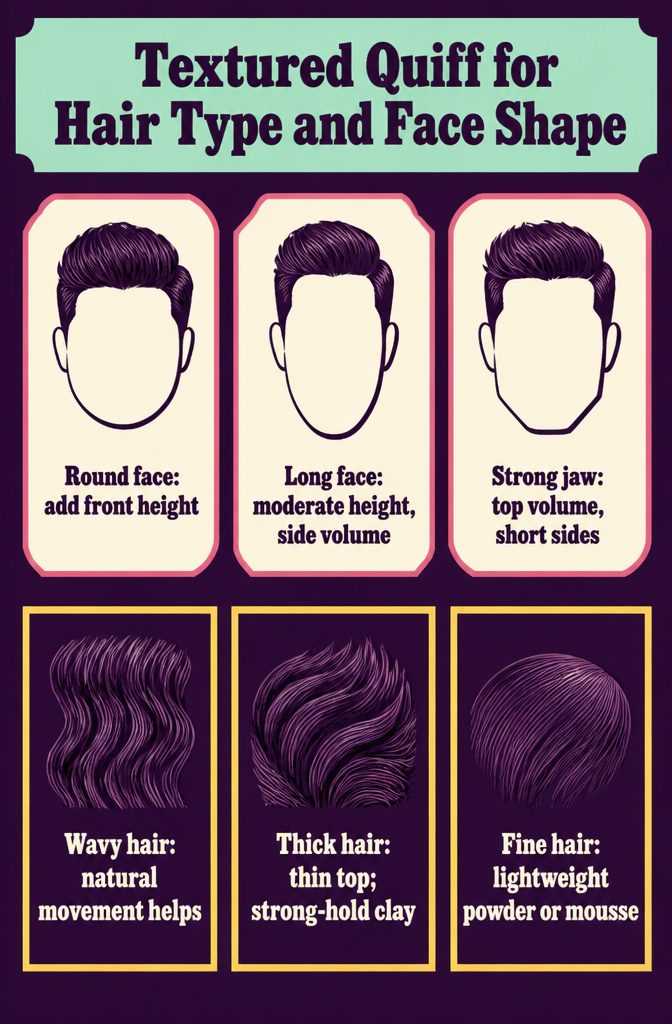
Round faces get the most from added height, since a taller front makes the face read longer.
Long faces want the opposite: moderate height with some side volume. A strong jaw does well with volume on top and short sides.
I’d call wavy hair the easiest start, because its natural movement supplies texture; scrunch in curl cream or sea salt spray and shape it with your fingers.
Thick hair holds a full quiff well, but ask the barber to thin the top slightly and use a strong hold clay.
Fine hair does better with lightweight texture powder or mousse, since heavy clay weighs it down, and very fine, straight hair needs a blow-dryer to keep its height.
Trim Schedule and Upkeep
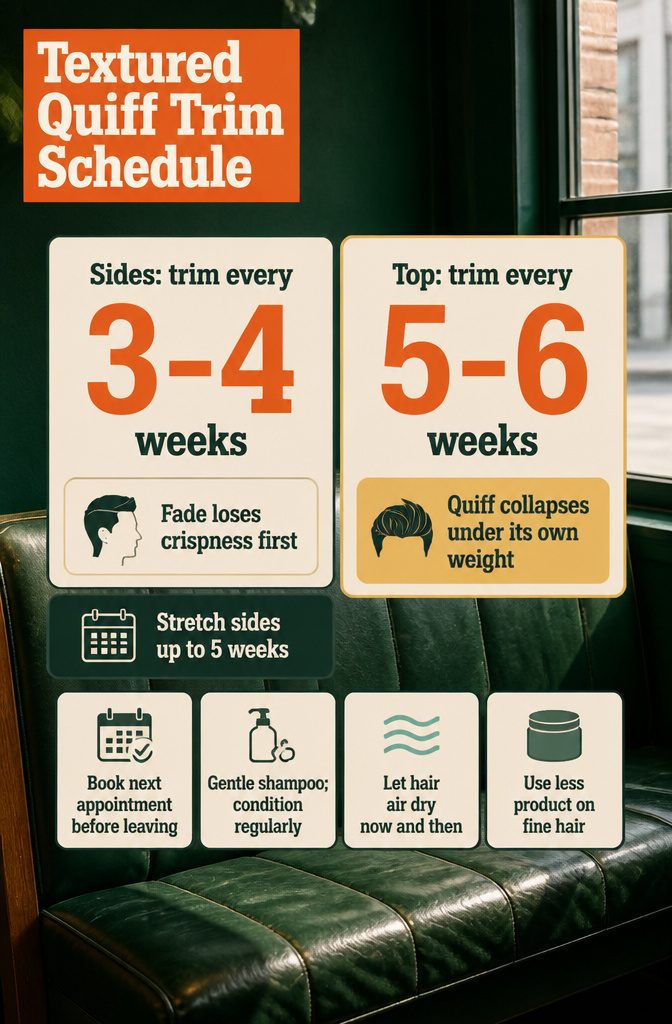
Sides go first.
A fade or taper loses its shape after 3–4 weeks, though how fast your hair grows and how sharp you want the edges decide whether you stretch to 5. The top outlasts them.
| Part | Trim every | Sign it’s time |
|---|---|---|
| Faded or tapered sides | 3–4 weeks (up to 5) | Fade stops looking crisp |
| Top | 5–6 weeks | Quiff collapses under its own weight |
Book the next appointment before you leave the chair.
Use a gentle shampoo, condition regularly, and let your hair air dry now and then, since heat dries it out. Fine hair flattens under heavy product, so use less.
Frequently Asked Questions
How do I ask my barber for a textured quiff?
Name the fade or taper and where it starts, then ask for a #1 blending to a #3 on the sides.
Ask for 3–4 inches at the front, shorter toward the crown, with point cutting so the top looks piecey instead of smooth. Bring front, side and back photos; the side shot shows the fade best.
What is the difference between a fringe and a quiff?
A fringe falls forward over the forehead, while a quiff stands up at the front and is usually swept back.
A textured crop also points its fringe forward, so if the hair in your reference photo is pushed toward the brow, that’s a crop and not a quiff.
What face shape is a quiff best for?
A quiff can work on most face shapes, but the height should change with the shape.
Round faces gain the most from added height, and a high fade slims them further. Long faces do better with moderate height and some side volume, and a strong jaw suits volume on top with short sides.
Is a quiff attractive?
Yes, it’s widely seen as stylish, confident and well-groomed, and it fits both the office and a casual weekend.
David Beckham, Zayn Malik and Mason Mount all wear it. It looks best when the top length and fade suit your hair type and face shape.
What is a modern textured quiff haircut?
It’s a lifted top over shorter faded or tapered sides, typically about 3 inches on top with a #1 blending to a #3, styled with matte clay.
Textured means the top is cut with choppy layers or point cutting and finished matte, so the strands separate instead of lying smooth. That makes it looser than the pomade-heavy 1950s original.
What is the difference between a quiff and a pompadour?
A pompadour is smooth, rounded and usually shiny.
A textured quiff is matte, messier and styled with your fingers instead of a comb. Both sweep the front up and back, so the difference is in the finish.
Do I need a hair dryer for a quiff?
For a true quiff, yes.
Roughly 80% of the look comes from blow-drying the front up and back, and product mostly holds the height the dryer builds. Skipping it gives a flatter, messier version that can still look good.
How long does hair need to be for a textured quiff?
Plan on 3–4 inches at the front, getting shorter toward the crown.
That length is what lets the hair build real height. A short quiff at 1.5–2 inches still gives a noticeable lift if you want less to manage.
Is a textured quiff good for thin hair?
It can be, if you keep the top short, since less length shows less scalp and the height reads as density.
Use lightweight texture powder or mousse, because heavy clay and shiny products pull fine strands flat. How full it looks still depends on your natural density, and no product fully makes up for that.
How do I style a short quiff?
Blow-dry the front up and back, then work in a pea-sized amount of styling cream.
At 1.5–2 inches the whole routine takes under a minute. Use less product than you think you need, since too much weighs a short top down.